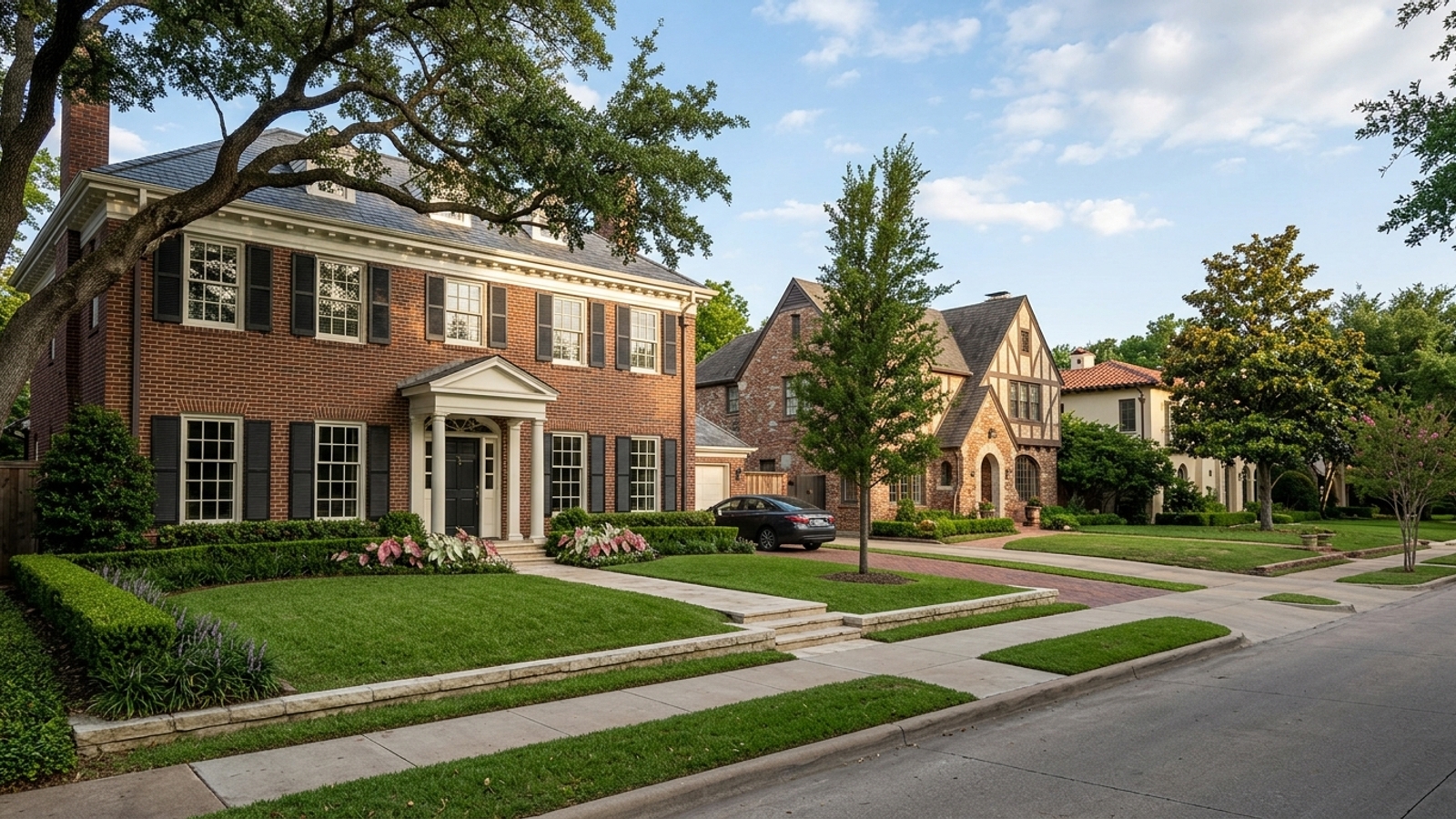
The median sale price for a home in Highland Park, TX, is currently around $2,998,000. At that price point, the down payment alone is a serious number, particularly for first-time home buyers in Highland Park, but it's not the only serious number you'll need to have ready.
Closing costs are a separate layer of cash due at the settlement table. They cover the administrative, legal, and financial services required to transfer the property into your name, and in a market like this one, they deserve their own line in your budget from day one.
What Are Closing Costs in Texas?
Closing costs are the collection of fees, taxes, and prepayments required to finalize a real estate transaction. Buyers and sellers both face closing expenses, though they're paying for entirely different services.
In Texas, the specific fees you'll encounter depend on whether you're securing a mortgage or paying cash. The state also has some customs around who pays for certain big-ticket items, title insurance being the main one, that tend to surprise buyers coming from other states.
Closing Costs vs. Down Payment
Your down payment goes directly toward the equity in your new home. It's the portion of the purchase price you're paying upfront rather than financing.
Closing costs don't build equity. They go toward third-party service providers, local government recording offices, and the escrow account that holds your future property tax payments. Different purpose, different bucket.
Buyer Costs vs. Seller Costs
The financial burden at the closing table is split between the two parties. Sellers in Texas typically face total costs ranging from 6% to 10% of the sale price, driven largely by real estate commissions.
Buyers usually pay between 2% and 5% of the purchase price, with that side consisting mostly of loan origination charges, appraisal fees, and prepaid property expenses.
How Much Do Buyers Pay in Closing Costs?
Texas buyers typically pay about 2% to 5% of the purchase price in closing costs. One statewide study found that average closing costs total 1.50% of the home's price, or an average of $4,548, which is lower than the national average.
That lower average, though, reflects the entire state, including areas with much lower property values. In Highland Park, where homes routinely sell for several million dollars, the absolute dollar amount will be substantially larger even if the percentage settles toward the lower end of that range.
Are Costs Always 3% of the Sale Price?
Many buyers use 3% as a starting estimate for settlement charges, and it's not a bad one. The final percentage will fluctuate based on your loan type and how much you pay in upfront points to lower your interest rate.
Property taxes also push this number around. Texas has higher property tax rates than many states, so the amount required to seed your escrow account can push your total cash to close well past 3%.
Dallas-Fort Worth Area Cost Factors
Highland Park currently sees homes sit on the market for roughly 50 days, with 29 active listings recently available. Buyers here often take out jumbo loans, which carry different underwriting fees and appraisal requirements than conventional mortgages.
At this transaction size, title insurance premiums and escrow reserves scale up proportionally. That's not a reason to panic. It's just a reason to get ahead of the math early, before you're under contract and the clock is ticking.
Sample Buyer Closing Costs by Home Price
Estimating your exact cash to close requires a formal Loan Estimate from your lender. Until you have that document, working from purchase price tiers gives you a realistic baseline.
The figures below reflect the typical 2% to 5% range. Cash buyers will come in lower, since they avoid all lender-related charges.
Example Breakdown for $300k to $600k Homes
For a $300,000 house in Texas, buyer closing costs generally fall between $6,000 and $15,000. On a $400,000 home, that range shifts to $8,000 to $20,000. A $500,000 property usually requires $10,000 to $25,000 in closing funds, and a $600,000 home typically runs between $12,000 and $30,000 at the settlement table.
Estimating Costs on a Highland Park Luxury Purchase
Applying those same percentages to the Highland Park median sale price of $2,998,000 produces a much larger figure. A 2% estimate puts closing costs around $60,000; a 5% estimate pushes the total near $150,000.
At this price tier, the percentage often skews closer to 2%. Lender fees tend to cap out, so the bulk of these costs typically comes from property tax prepayments and title policies rather than origination charges.
Itemized Breakdown of Buyer Closing Costs
A settlement statement contains dozens of individual line items. Knowing what each fee covers is how you figure out where there's room to push back.
These expenses generally fall into four categories: lender fees, title charges, government fees, and prepaid expenses. Here's how they break down for a Texas buyer.
Mortgage and Lender Fees
If you're financing the purchase, the lender will charge an origination fee for processing and underwriting the loan, often around 0.5% to 1% of the total loan amount. You'll also pay for a home appraisal to verify the property's value, which typically costs a few hundred dollars. Credit report pulls and flood certification fees round out the minor charges.
Title Insurance Rules in Texas
Title insurance premiums in Texas are set by the state, so every insurer charges the exact same base rates. An owner's policy generally costs between 0.6% and 0.9% of the purchase price.
The Texas base premium rate chart lists specific costs at various price points: $832 for a $100,000 purchase, $1,886 on $300,000, $2,940 on $500,000, and $5,575 on a $1 million purchase. Rates have recently moved in buyers' favor. The Texas Department of Insurance implemented a statewide 10% reduction in premium rates effective July 1, 2025, and the Commissioner approved a further 6.2% basic premium rate decrease that took effect on March 1, 2026.
Escrow Fees and Dallas County Recording
The title or escrow company charges a settlement fee for managing the transaction and disbursing funds. That fee is separate from the insurance premium and varies by company.
Dallas County recording fees are modest and page-based: $25 for the first page of a document and $4 for each additional page. Texas also has a meaningful tax advantage worth knowing: the state does not impose a real estate transfer tax on property sales, a prohibition that has been enshrined in the state constitution since 2016. Neither you nor the seller owes it.
Prepaids and Escrow Reserves
Lenders require buyers to pay for certain property expenses in advance. You'll need to purchase a full year of homeowners insurance upfront before the loan closes, and you must deposit several months of property taxes and insurance premiums into an escrow account.
Because Texas property taxes are a large annual expense, that reserve deposit is often the single largest line item on your closing disclosure. Don't let it catch you off guard.
Who Pays Closing Costs: Buyer or Seller?
Real estate contracts dictate who pays for specific closing costs, and in Texas, local custom does a lot of the heavy lifting on that question. While almost any fee can be negotiated, most standard Texas Real Estate Commission (TREC) contracts are written with a specific set of expectations already baked in.
What the Buyer Customarily Pays
Buyers commonly pay all charges associated with their mortgage: origination fees, appraisal, credit checks, and the lender's title insurance policy. You're also responsible for your own property inspections and the initial funding of your escrow account. If a survey is required and the seller doesn't have a current one, the buyer often picks up that cost too.
What the Seller Customarily Pays
In Texas, sellers customarily pay for the owner's title insurance policy. That's the reverse of how it works in many other states, and it's one of the more buyer-friendly Texas customs worth knowing about.
Sellers also cover real estate agent commissions, which often run 5% to 6% of the sale price, plus property taxes prorated up to the day of closing.
Can Sellers Cover Buyer Costs?
Many fees remain negotiable, and credits can shift costs between parties. A buyer can ask the seller to contribute a specific dollar amount toward the buyer's closing costs. This is called a seller concession.
Whether a seller agrees depends on market conditions, how long the home has been sitting, and the strength of your overall offer. It's a conversation worth having, but it's not a given.
Estimating Your Costs: A Worked Example
Reviewing a hypothetical transaction makes this concrete. The exact numbers will vary based on your lender and property, but the structure stays the same. This example assumes a buyer securing a standard mortgage.
Financed Purchase Example
Consider a buyer purchasing a $500,000 home with a 20% down payment, leaving a $400,000 loan. A 1% origination fee comes to $4,000. Add roughly $500 for an appraisal, a few hundred dollars in escrow settlement fees, and the Dallas County recording fees. Then layer on a full year of homeowners insurance prepaid upfront, plus the property tax escrow deposit, and your total cash to close lands well beyond the down payment alone.
Cash Purchase Example
Cash buyers skip the mortgage process entirely, which eliminates a significant portion of the closing costs. No origination fees, no appraisal fees, no lender's title insurance, no lender-mandated escrow account for taxes and insurance.
What remains is your share of the settlement fees, government recording charges, and any optional inspections you choose to order. It's a much shorter list.
How to Reduce Your Closing Costs in Texas
There are a few real ways to lower your out-of-pocket expenses at the settlement table. You can't change state-mandated title rates or county recording fees, but other costs offer genuine flexibility. Taking the time to explore them before you sign a contract can keep thousands of dollars in your pocket.
Negotiating Seller Concessions
Your agent can negotiate a seller credit during the initial offer phase or after the home inspection. If the inspection surfaces necessary repairs, the seller might offer a closing cost credit rather than fix the issue themselves. That's a common outcome.
Lenders do cap how much a seller can contribute. For conventional investment properties, that cap might be 2%, while primary residences can see caps up to 6% or 9% depending on the down payment.
Shopping for Lender Credits
Compare loan estimates from multiple lenders to find the lowest origination fees. It's worth the time. You can also opt for a lender credit, where the lender covers some of your closing costs in exchange for a slightly higher interest rate.
That trade reduces your upfront cash requirement but raises your monthly payment. How long you plan to stay in the home should drive that decision.
Frequently Asked Questions
What are typical buyer closing costs on a $400,000, $500,000, or $600,000 home in Texas?
Texas buyers typically pay between 2% and 5% of the purchase price. This means closing costs range from $8,000 to $20,000 on a $400,000 home, $10,000 to $25,000 on a $500,000 home, and $12,000 to $30,000 on a $600,000 home. Cash buyers will see costs at the lower end of these ranges.
Are buyer closing costs usually about 3% of the sale price in Highland Park, TX?
Yes, 3% is a common rule of thumb, but it is only an estimate. In Highland Park, where the median sale price is roughly $2,998,000, the final percentage often skews closer to 2% because lender fees cap out. High property tax escrow requirements can push the total back up depending on the closing date.
Who pays for title insurance, escrow, and transfer taxes at closing in Texas?
In Texas, sellers customarily pay for the owner's title insurance policy, while buyers pay for the lender's title policy. Escrow and settlement fees are typically split or negotiated between the two parties. Texas does not have a real estate transfer tax, so neither party pays one.
Can I negotiate closing costs or have the seller pay them when buying a house in Highland Park?
Yes, buyers can negotiate to have the seller cover some closing costs through a seller concession. While Highland Park homes recently sold for about 95% of their list price, indicating some room for negotiation, seller credits depend entirely on the strength of your offer. The seller must agree to the terms in the purchase contract.
How do I calculate my exact closing costs as a buyer in Texas before receiving the final Closing Disclosure?
You can calculate a close estimate by reviewing the Loan Estimate provided by your lender within three days of your mortgage application. For state-set fees, you can check the Texas base premium rate chart, which lists title insurance costs at specific price points. Adding these known premiums to your lender's estimated origination and escrow fees will give you an accurate total.
How are Highland Park's local property taxes prorated and funded in escrow at closing?
The seller pays for property taxes prorated up to the day of closing. The buyer then takes over the tax burden and must deposit several months of future property taxes into an escrow account. The title company handles this math at the settlement table to ensure both parties only pay for the exact days they own the home.
Can buyers get assistance with down payments and closing costs?
Buyers looking to offset their initial cash requirements can sometimes find local assistance options. Certain homebuyer programs in Highland Park are designed to help reduce out-of-pocket expenses at the settlement table. These initiatives generally assist with down payments or settlement fees for those who meet the qualifications.